How much protein do you need on a GLP-1 medication?
When appetite drops, protein is often the first thing to go. Here's how much to aim for and how to get it when you're barely hungry.
GLP-1 medications such as semaglutide (Ozempic, Wegovy) and tirzepatide (Mounjaro, Zepbound) are very good at one thing: making you less hungry. That's why they work. It's also why many people on them end up eating far too little protein without noticing.
This article is general information, not medical advice. Your prescriber or a registered dietitian can tailor targets to your health, kidney function and medication.
Why protein matters more on a GLP-1
When you lose weight, you don't only lose fat. Some of what comes off is lean mass, which includes muscle. In the large clinical trials, body-composition scans showed that lean mass made up a meaningful share of total weight lost: roughly a quarter in tirzepatide trials and up to around a third or more in semaglutide trials.
Some lean-mass loss is expected with any weight loss. But muscle matters for strength, blood sugar control, metabolism and how you feel as you age. And when appetite is suppressed, it's easy to fill the few bites you do eat with toast, crackers or snacks instead of protein.
The two things most strongly linked with keeping muscle while losing weight are eating enough protein and resistance training.
How much to aim for
There is no single official number for people on GLP-1s, but most clinical guidance for adults losing weight lands in the same range:
If you have a lot of weight to lose, calculate it from your goal weight (or a healthy reference weight) rather than your current weight.
Examples:
| Goal weight | Daily protein (1.2–1.6 g/kg) |
|---|---|
| 60 kg (132 lb) | 72–96 g |
| 70 kg (154 lb) | 84–112 g |
| 80 kg (176 lb) | 96–128 g |
| 90 kg (198 lb) | 108–144 g |
For most people that works out to somewhere around 80–120 g a day. If you have kidney disease, check with your doctor before increasing protein.
Spread it across the day
Your body uses protein for muscle repair more effectively when it arrives in decent portions rather than all at once. Aim for roughly 25–35 g at each of three meals, and fill the gap with a protein-rich snack if needed.
On a GLP-1 that can feel like a lot of food. The trick is to eat the protein first, before the sides. If you get full after five bites, make them the right five bites.
Protein foods that are easy to eat with a small appetite
When you're on a GLP-1, soft, cool and lean options usually go down easier than large, greasy meals.
| Food | Typical portion | Protein |
|---|---|---|
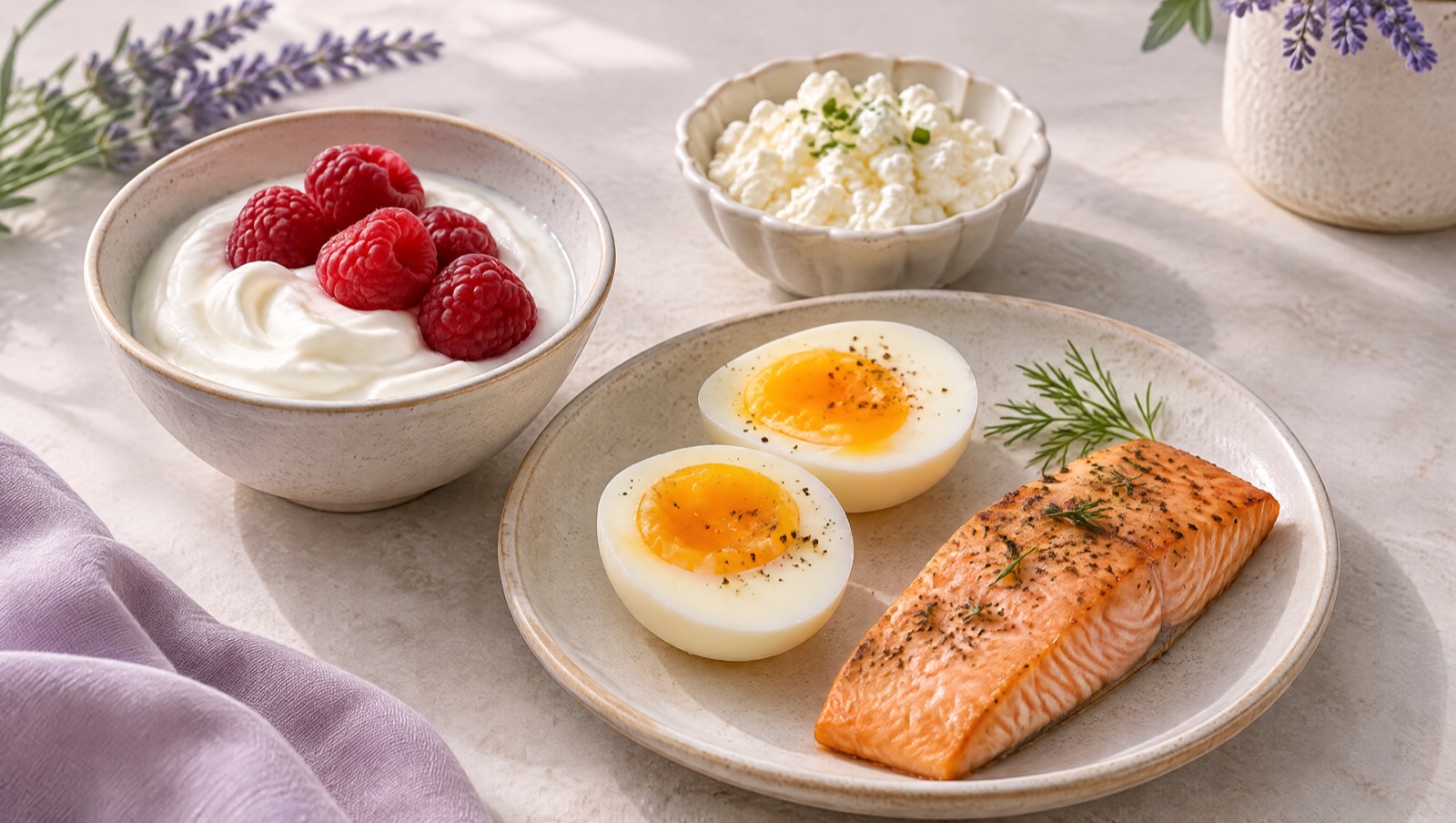
| Greek yogurt (plain, 0–2%) | 200 g | ~20 g |
| Cottage cheese | 150 g | ~17 g |
| Eggs | 2 large | ~12 g |
| Chicken breast, cooked | 100 g | ~31 g |
| Canned tuna | 1 can (drained, ~110 g) | ~25 g |
| Salmon, cooked | 100 g | ~22 g |
| Firm tofu | 150 g | ~18 g |
| Lentils, cooked | 200 g | ~18 g |
| Protein shake | 1 serving | 20–30 g |
| Skyr or high-protein pudding | 1 pot | 15–20 g |
Values are approximate and vary by brand.
A sample high-protein day on a small appetite
- Breakfast: Greek yogurt with berries and a spoon of nut butter (~25 g protein)
- Lunch: Half a tuna or chicken wrap plus a few cherry tomatoes (~25 g)
- Snack: Protein shake or a pot of skyr (~20 g)
- Dinner: A palm-sized piece of salmon with a small portion of rice and vegetables (~25 g)
Total: roughly 95 g of protein, in portions that are realistic when your appetite is low.
Don't skip the strength training
Protein provides the building blocks; resistance training gives your body the reason to keep muscle. Two or three sessions a week of anything that challenges your muscles counts: weights, machines, resistance bands or bodyweight exercises like squats, push-ups and rows. Start light and build up.
Signs you might be under-eating protein
- Feeling weak or getting tired quickly during everyday tasks
- Strength going down at the gym
- Hair shedding more than usual a few months into weight loss
- Weight dropping very quickly while you're eating very little overall
If you notice these, talk to your prescriber. And for a week, simply log what you eat. Most people are surprised by how little protein they're actually getting.
The short version
- Aim for 1.2–1.6 g of protein per kg of goal weight, usually 80–120 g a day.
- Split it into 25–35 g per meal and eat the protein first.
- Lean on soft, easy foods: yogurt, cottage cheese, eggs, fish, tofu and shakes.
- Pair it with resistance training two or three times a week.
This article is for general information and isn’t a substitute for advice from your doctor or a registered dietitian.
Let the app do the math
EatCount tracks calories and protein from a photo or a sentence. Join the waitlist for early access.