How to count calories for weight loss
Find your number, log without obsessing, and read the scale the right way. A step-by-step guide with a worked example.
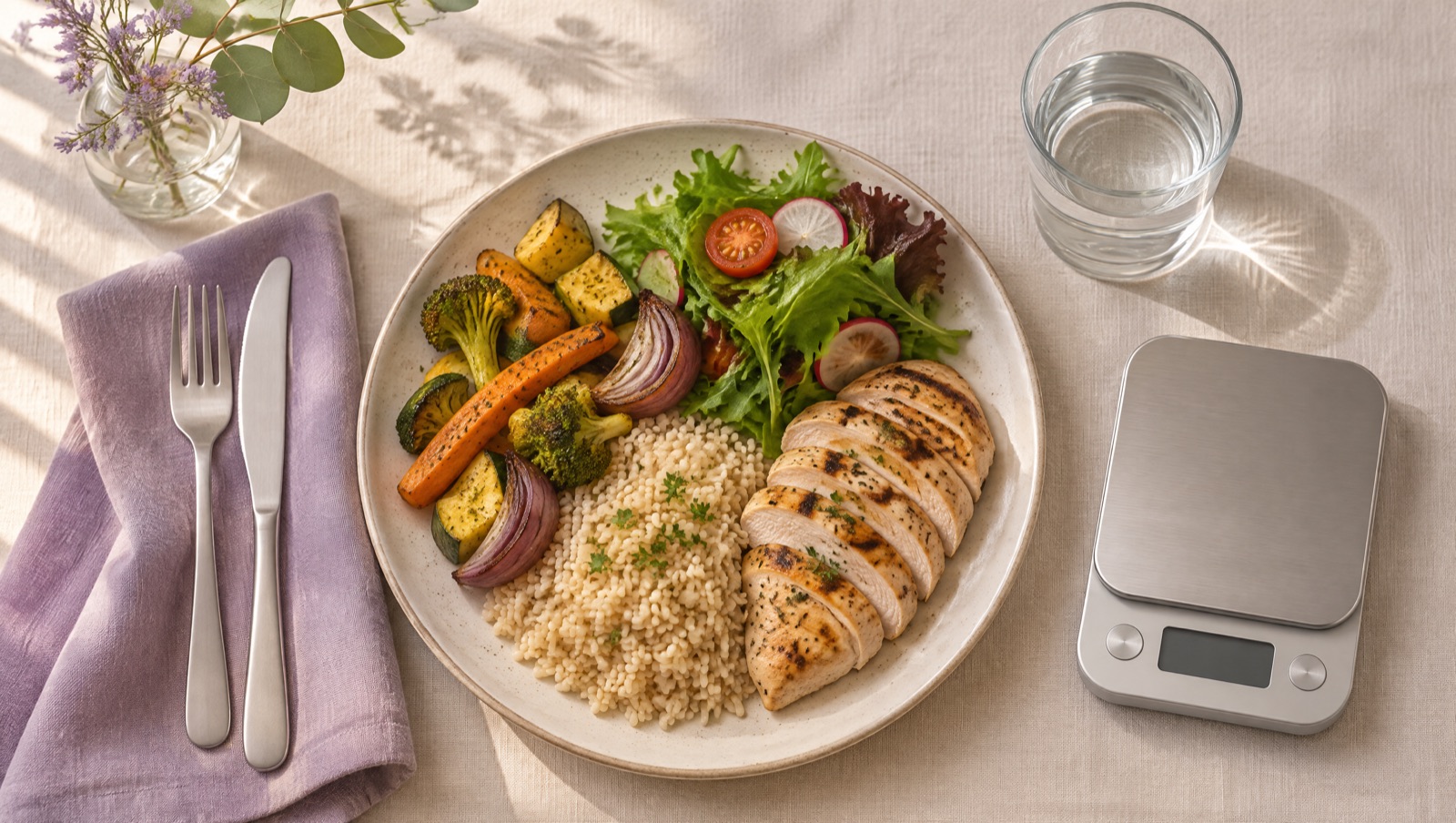
Calorie counting has a reputation for being tedious and joyless. It doesn't have to be. Done well, it is less about restriction and more about getting honest data on what you eat, so you can make a few changes that actually move the needle.
This guide walks you through the whole process: estimating your daily target, choosing a deficit you can live with, logging accurately and interpreting what the scale tells you.
Step 1. Estimate how much you burn
Your body burns energy in three main ways: keeping you alive at rest (basal metabolic rate, or BMR), digesting food, and moving. Together these make up your total daily energy expenditure (TDEE). You can't measure it precisely at home, but you can estimate it well enough to start.
The most widely used formula for BMR is Mifflin–St Jeor:
- Men: 10 × weight (kg) + 6.25 × height (cm) − 5 × age + 5
- Women: 10 × weight (kg) + 6.25 × height (cm) − 5 × age − 161
Then multiply by an activity factor:
| Your typical week | Multiply BMR by |
|---|---|
| Desk job, little exercise | 1.2 |
| Light exercise 1–3 days a week | 1.375 |
| Moderate exercise 3–5 days a week | 1.55 |
| Hard exercise 6–7 days a week | 1.725 |
Most people overestimate their activity. If you're unsure between two levels, pick the lower one.
BMR = 10 × 78 + 6.25 × 168 − 5 × 35 − 161 = 780 + 1,050 − 175 − 161 = 1,494 kcal.
TDEE ≈ 1,494 × 1.375 = about 2,050 kcal a day.
Step 2. Choose a deficit you can actually keep
To lose fat you need to eat a bit less than you burn. A deficit of 300–500 kcal a day is a good starting point for most people. It usually leads to roughly 0.3–0.5 kg (about 0.5–1 lb) of loss per week once the early water-weight swing settles.
In the example above, that puts her daily target around 1,550–1,750 kcal.
Bigger deficits work faster on paper, but they tend to backfire: more hunger, lower energy, more muscle loss and a higher chance of quitting. As a general rule, don't go below about 1,200 kcal a day for women or 1,500 for men without a doctor or dietitian involved.
Step 3. Set a protein floor
Calories decide how much weight you lose. Protein helps decide what you lose. Eating enough protein while in a deficit helps preserve muscle and keeps you fuller between meals. A practical target for most adults trying to lose weight is 1.2–1.6 g of protein per kg of body weight (if you have a lot of weight to lose, use your goal weight instead).
For our example, that's roughly 95–125 g of protein a day. An easy way to get there is to build each meal around a protein source: eggs or Greek yogurt at breakfast, chicken, fish, tofu or beans at lunch and dinner.
Step 4. Log what you eat (accurately enough)
You don't need to weigh every lettuce leaf. You do need to catch the things that add up quietly. Research on dietary self-reporting consistently finds that people under-report what they eat, often by a wide margin. The usual suspects:
- Cooking oil and butter. One tablespoon of oil is about 120 kcal, and it's easy to pour two.
- Drinks. Lattes, juice, smoothies, soda and alcohol. A large flavored latte can be 300+ kcal.
- Sauces and dressings. Mayo, pesto, creamy dressings, peanut butter.
- Bites, tastes and finishing the kids' plates.
- Weekends. Two loose days can erase the deficit from five careful ones.
Tips that make logging faster:
- Log as you eat, not at the end of the day. Memory is the biggest source of error.
- Weigh the calorie-dense foods (oils, nuts, cheese, pasta, rice) for the first couple of weeks. You'll quickly learn to eyeball them.
- Save meals you eat often so you can add them in one tap.
- For restaurant meals, log your best estimate and round up. A rough entry beats no entry.
Step 5. Read the scale like a scientist
Daily weight jumps around by 0.5–2 kg because of water, salt, carbs, hormones and what's still in your gut. One high reading means almost nothing.
- Weigh yourself at the same time (morning, after the bathroom, before eating).
- Look at the weekly average, not single days.
- Judge your plan after 2–3 weeks, not 2–3 days.
- Track your waist measurement too. It often moves when the scale is stuck.
Step 6. Adjust, don't restart
If your weekly average hasn't changed in 3 weeks and you've been logging honestly, lower your target by 100–150 kcal or add some daily walking. As you lose weight, your TDEE also drops a little, so it's normal to recalculate every 4–5 kg lost.
If you're losing much faster than 1% of your body weight per week, feel exhausted or are constantly hungry, eat a bit more. Slower and sustainable beats fast and abandoned.
Common questions
Do I have to count calories forever?
No. Many people track closely for a few months, learn what portions look like and then switch to tracking a few days a week or only when the trend drifts up.
Are all calories equal?
For weight change, energy balance matters most. For hunger, energy, muscle and health, food quality matters a lot. Protein, fiber and whole foods make the same calorie target much easier to stick to.
Should I eat back exercise calories?
Fitness trackers often overestimate calories burned. If you eat some back, start with about half.
The short version
- Estimate your TDEE with Mifflin–St Jeor and an honest activity level.
- Eat 300–500 kcal below it.
- Hit a daily protein floor.
- Log as you go, especially oils, drinks and weekends.
- Judge progress by weekly averages over 2–3 weeks, then adjust by small steps.
This article is for general information and isn’t a substitute for advice from your doctor or a registered dietitian.
Let the app do the math
EatCount tracks calories and protein from a photo or a sentence. Join the waitlist for early access.